This guide explains how to interpret “226 Cf,” why the notation is generally read as californium-226, and which scientific checks are needed before treating it as a recognized isotope or material specification. It distinguishes atomic number from mass number, reviews isotope naming conventions, discusses nuclear stability, and outlines responsible ways to verify nuclear-data claims through authoritative databases, laboratory records, and regulatory documentation.
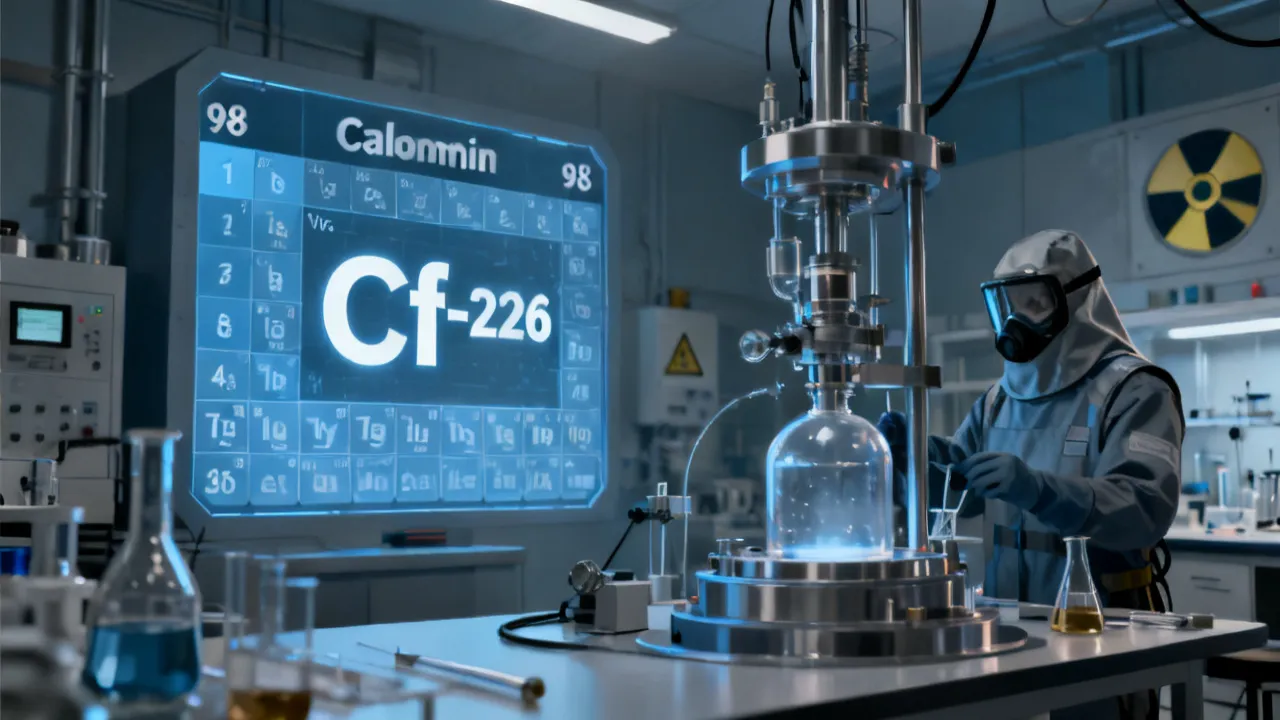
The expression “226 Cf” appears to be a nuclear notation involving the element californium, whose chemical symbol is Cf and whose atomic number is 98. In conventional isotope notation, the number 226 would normally represent the mass number, producing the form californium-226, commonly written as ²²⁶Cf or Cf-226.
The very important point is that notation alone does not establish that a particular isotope is recognized, routinely produced, commercially supplied, or available for laboratory use. A specialist must first determine whether the term refers to a genuine nuclide entry, a transcription error, a catalog identifier, an internal project code, or a reference to another isotope. This distinction matters because nuclear materials are identified through precise scientific, regulatory, and documentary systems rather than through shorthand alone.
For readers encountering “226 Cf” in a research note, database, product description, educational text, or online discussion, the safest interpretation is therefore conditional: it likely describes a proposed or purported californium isotope with mass number 226, but the claim requires verification. The notation should not automatically be treated as evidence of a confirmed, characterized, or obtainable nuclear material.
In practical terms, the expression should be read in two stages. First, its symbolic meaning can be decoded using the standard rules of nuclear notation. Second, its scientific status must be established by consulting suitable nuclear-data sources. These two stages are related but not identical. A person can correctly calculate the neutron number associated with a notation while still lacking evidence that a long-lived or physically recoverable sample has ever existed.
Isotope notation communicates two central facts about an atomic nucleus:
For californium, the atomic number is always 98. Every californium atom has 98 protons, regardless of its isotope. The mass number varies according to the number of neutrons. In the notation ²²⁶Cf, the superscript 226 would indicate the total number of protons and neutrons.
The neutron count can be calculated by subtracting the atomic number from the mass number:
Neutron number = Mass number − Atomic number
For the notation ²²⁶Cf:
226 − 98 = 128 neutrons
Thus, a nucleus described as californium-226 would contain 98 protons and 128 neutrons. This arithmetic explains the notation, but it does not by itself confirm whether the nuclide has been observed, how long it survives, or whether it has recognized decay data.
| Symbol or Term | Meaning | Application to 226 Cf |
|---|---|---|
| Cf | Chemical symbol for californium | Indicates an element with 98 protons |
| 226 | Mass number in isotope notation | Indicates 98 protons plus 128 neutrons if the notation is literal |
| Californium-226 | Written-out isotope name | A possible reading of “226 Cf” requiring nuclear-data verification |
| Atomic number 98 | Defines the element | Remains constant across all californium isotopes |
| Mass number | Total protons and neutrons | Distinguishes one isotope from another |
The order of the symbols can vary between informal and formal writing. Scientific notation usually places the mass number as a superscript to the left of the element symbol, and sometimes places the atomic number beneath it. In plain text, however, writers commonly use forms such as “Cf-226,” “californium 226,” or “226Cf.” These versions may be understandable, but a formal document should use a consistent convention and define it when ambiguity is possible.
It is also useful to distinguish the words element, isotope, and nuclide. Californium is the element. Californium-226 would be a particular isotope or nuclide associated with that element. “Nuclide” is a more specific term referring to a nucleus characterized by a particular number of protons and neutrons. The distinctions become important when discussing nuclear data, because chemical behavior is mainly governed by proton number and electron arrangement, while radioactive behavior depends strongly on the detailed nuclear composition.
Californium is a synthetic chemical element in the actinide series. It is identified by the symbol Cf and atomic number 98. Like other actinides, it is associated with nuclear science, radiochemistry, materials research, and specialized analytical applications. Californium is not found in ordinary consumer products, and its compounds and isotopes require controlled handling because of radioactive emissions and the potential radiological hazards associated with them.
The element was first produced in the twentieth century through nuclear reactions involving lighter actinide material. Its name derives from California, reflecting the location associated with its discovery. The element belongs to a part of the periodic table in which nuclear structure is especially important: many isotopes are radioactive, and their properties are governed by competing decay modes, nuclear shell effects, production pathways, and half-life limitations.
Several californium isotopes are known and studied, but they are not interchangeable. Their half-lives, decay energies, spontaneous-fission probabilities, daughter products, and practical applications can differ substantially. In professional writing, a californium reference should therefore include the exact mass number, the measurement basis, and the source of the nuclear data.
Californium is positioned among the heavier actinides, where the balance between the strong nuclear force and electrostatic repulsion among protons becomes increasingly consequential. As proton number rises, the nucleus generally requires an appropriate neutron complement to remain comparatively stable. Even then, the resulting isotopes are radioactive, and some are sufficiently short-lived that they are primarily studied through their production and decay rather than through conventional storage.
The chemical identity of californium also has practical significance. Although isotope changes do not normally alter the element’s basic chemical symbol, radioactive decay can transform the atom into a different element. A californium nucleus undergoing alpha decay, for example, loses two protons and two neutrons, producing a daughter nucleus with a different atomic number. This means that a radioactive sample may gradually develop daughter products whose chemical and radiological properties must be considered in a complete analysis.
A notation can be mathematically valid while still being scientifically incomplete. The term “226 Cf” may be read using standard isotope conventions, yet the status of that nuclide must be checked against an authoritative nuclear-data evaluation. A reliable assessment would typically examine whether the nuclide is:
This verification process is particularly important for nuclei far from the region of long-lived californium isotopes. As the proton-to-neutron balance changes, nuclear stability generally becomes more difficult to maintain. Very short-lived nuclei may exist only briefly after a reaction and may be identified through decay chains, correlated detector signals, or other indirect evidence. In such cases, the terminology “isotope,” “predicted nuclide,” “candidate event,” and “confirmed nuclide” should not be used interchangeably.
An industry expert would also check the context in which the term appears. A scientific publication may use “Cf-226” as a proposed isotope, a reaction product, or a notation under investigation. A vendor page may contain a typographical error or confuse californium with another element. A software file may use a numerical code unrelated to mass number. The surrounding information is essential.
Verification should also account for the possibility that different sources use different levels of confidence. A historical paper may report an early assignment that was later revised. A nuclear chart may list a nuclide as experimentally known while providing only limited decay information. A theoretical database may include a broad range of predicted nuclei for modeling purposes. Therefore, presence in a database is a starting point for investigation, not always the end of it.
One of the very frequent errors in nuclear terminology is the assumption that the mass number alone identifies an element. It does not. The element is determined by proton count, while the isotope is determined by both proton count and neutron count.
For example, mass number 226 can be associated with different elements, including radium-226 and other nuclides. These substances do not share the same chemical identity or nuclear behavior. Radium-226 has a different atomic number from californium-226, so the two must not be treated as equivalent. Confusing the element symbol or copying a mass number without its atomic number can lead to serious errors in research, safety assessments, and regulatory documentation.
The notation should therefore be read as a complete unit:
²²⁶₉₈Cf
The upper number, 226, is the mass number. The lower number, 98, is the atomic number. In many modern texts, the atomic number is omitted because the chemical symbol already identifies the element. Even so, the full notation helps demonstrate why the identity is specific.
This distinction is especially important in databases and spreadsheets, where an isolated number may be separated from its element symbol. A column headed “mass” may contain mass numbers, atomic masses, or even sample identifiers. A column headed “A” usually denotes mass number, whereas “Z” commonly denotes atomic number. Confusing the two can produce a completely different nuclear identity. Technical records should therefore use explicit headings and, where possible, a standardized nuclide identifier.
When someone searches for “226 Cf,” several interpretations are possible. They should be ranked according to context rather than assumed to be identical.
The phrase may refer to californium with mass number 226. This is the very direct nuclear-notation interpretation. It still requires confirmation of the nuclide’s status and data quality.
The number may have been copied incorrectly from a document, image, spreadsheet, or database. Californium is associated with several better-known isotope designations, so a misplaced digit is plausible. A careful review should compare the reference with the original source and surrounding isotope entries.
Some facilities assign numbers to samples, experiments, irradiation targets, or analytical runs. In that context, “226 Cf” may not follow standard isotope notation at all. A laboratory’s nomenclature guide, chain-of-custody record, or sample manifest would be needed to interpret it.
Data systems sometimes combine an element abbreviation with a number representing a row, record, reaction, or reference. Such a code should not be confused with a nuclide unless the software documentation explicitly defines it that way.
Nuclear theory may predict properties for nuclei that have not been directly observed or that have not received a complete evaluated data entry. In this case, the term should be presented as a prediction or candidate rather than as an established material.
In scanned documents or low-resolution images, the letters “Cf” may be mistaken for another abbreviation. A handwritten “Cf” can also resemble unrelated symbols. If the surrounding document discusses a different region of the periodic table, the symbol should be checked against the original source rather than interpreted in isolation.
A reaction equation may contain a mass number that identifies an intermediate or daughter product. In that setting, the notation may appear only as part of a decay chain and may not refer to an independently prepared sample. The reaction context, daughter products, and conservation of mass and charge should all be examined.
All recognized californium isotopes are radioactive. Radioactivity means that the nucleus can transform spontaneously into another nuclear state or nuclide while releasing energy. The rate of this process is described by the half-life, which is the time required for half of a statistically large population of identical radioactive nuclei to decay.
A half-life is not a deadline at which every atom disappears. Individual nuclear decays are probabilistic. After one half-life, approximately half of the original population remains; after two half-lives, approximately one quarter remains; after three, approximately one eighth remains. The exact behavior of a small sample can fluctuate, but the statistical law is highly reproducible for a sufficiently large population.
For a hypothetical or uncertain designation such as 226 Cf, it is inappropriate to state a half-life without a reliable source. A value may be experimental, evaluated, calculated, or merely repeated from an unverified page. These categories have different evidentiary weight. The source should identify the measurement method, uncertainty, decay mode, and evaluation date.
Californium isotopes may undergo alpha decay, spontaneous fission, or other decay processes depending on the specific nuclide. The decay mode affects radiation protection, detector selection, daughter-product analysis, shielding design, and waste classification. A generic statement about “californium radiation” is therefore less useful than a nuclide-specific assessment.
The decay constant and half-life are related mathematically by the expression:
λ = ln(2) ÷ T1/2
where λ is the decay constant and T1/2 is the half-life. Activity is then related to the number of radioactive atoms by A = λN. These relationships are useful when a verified half-life and isotope inventory are available. They should not be used to generate a confident activity estimate for an unverified designation. A calculation is only as reliable as the nuclear data and sample information supplied to it.
Confirmation of a nuclide usually involves more than observing a single radiation signal. Researchers may combine several lines of evidence, such as:
For extremely short-lived products, decay-chain analysis may be central. A detector records an event, then observes a second event at a position and time consistent with a known daughter decay. Repeated correlations can strengthen the identification. However, the interpretation must account for background events, detector efficiency, statistical significance, and possible alternative assignments.
In a scholarly article, the claim should be phrased with suitable precision. “The isotope was observed” is stronger than “the data are consistent with the isotope.” “Evaluated half-life” is different from “predicted half-life.” “Produced in a reaction” does not necessarily mean “isolated as a bulk sample.” These distinctions are fundamental in nuclear science.
Mass spectrometry can provide another route to identification, but it too has limitations. The instrument must distinguish the relevant mass-to-charge ratio from neighboring species and account for molecular ions, isobaric interference, detector calibration, and chemical preparation. In many heavy-element experiments, a combination of mass information and decay behavior is more persuasive than either type of evidence alone.
Scientists also consider conservation laws. A proposed production reaction must conserve charge, nucleon number, energy, and momentum. These checks do not prove that the reaction occurs at a useful rate, but they can expose an impossible or incorrectly transcribed equation. A credible report usually states the target, projectile, emitted particles, compound nucleus, and observed products clearly enough for other researchers to evaluate the assignment.
Californium isotopes are produced through specialized nuclear reactions, often involving neutron capture, irradiation, charged-particle reactions, or decay of heavier precursor nuclides. The route depends on the desired isotope and on the available target, beam, reactor, accelerator, and separation facilities.
Production of a specific nuclide may be limited by several factors:
These constraints are especially important when dealing with a nuclide that may be short-lived or difficult to distinguish from neighboring products. A theoretical production pathway is not the same as a practical supply route. A reaction equation may show that a nucleus can be formed, but it does not prove that a measurable quantity can be collected or transported.
In addition, high-activity nuclear materials are not ordinary laboratory commodities. Procurement, possession, transportation, storage, and disposal may require authorization from national or regional regulators. The exact requirements depend on jurisdiction, activity, chemical form, facility category, and intended use.
Production yield is often expressed in terms of cross section, atoms produced, activity, or recovered mass. These quantities should not be treated as interchangeable. A high activity may result from a small number of atoms if the half-life is short, while a longer-lived isotope can contain more atoms but produce less activity per unit mass. Similarly, a calculated yield at the target does not necessarily equal the amount recovered after chemical separation and encapsulation.
For this reason, a claim that a nuclide “can be produced” should be qualified. It may mean that a reaction is physically possible, that a few decay events have been detected, that a measurable tracer amount was created, or that a source suitable for routine use can be manufactured. These are very different levels of practical achievement.
The symbol Cf identifies the element, but a real material would also have a chemical and physical form. Californium could be present as a compound, an ion in solution, a deposited layer, a target material, or a trace component in a mixed actinide sample. Each form creates different handling and measurement considerations.
Chemical form affects solubility, volatility, surface contamination, containment, waste treatment, and analytical preparation. A sealed source, for example, is assessed differently from an unsealed solution. A target mounted inside an irradiation assembly presents different engineering concerns from a small analytical sample.
For that reason, a complete material description would normally include the isotope, elemental or chemical composition, physical form, activity at a stated reference date, measurement uncertainty, container specification, and documentation of origin. “226 Cf” by itself is not a sufficient purchasing, safety, or inventory specification.
The physical form also affects how the material is measured. A sealed source may be characterized using calibrated gamma spectrometry or source-strength measurements, while an unsealed actinide solution may require radiochemical separation, alpha spectrometry, liquid scintillation techniques, or mass spectrometric analysis. The analytical method must be appropriate to the expected emissions and matrix.
Radioactive decay can alter the composition over time. A certificate that accurately describes a source on one date may need decay correction for a later date. If daughter products grow in, the radiological profile may also change. Consequently, records should state the reference date, the activity units, the measurement uncertainty, and the assumptions used in any decay calculation.
Anyone working with radioactive material should apply the standard principles of justification, optimization, and dose limitation within the applicable regulatory framework. Practical controls commonly include time, distance, shielding, containment, contamination monitoring, personal dosimetry, and documented operating procedures.
The correct shielding depends on the radiation type and energy. Alpha particles have limited penetration but can create a serious internal hazard if radioactive material enters the body. Gamma rays are more penetrating and may require dense shielding. Spontaneous-fission emissions can include neutrons and accompanying gamma radiation, which may require specialized assessment. No single shielding statement is suitable for every californium isotope or source configuration.
Work with radioactive actinides should be conducted only by trained personnel in an appropriately authorized facility. Readers should not attempt to obtain, synthesize, handle, or test an alleged 226 Cf sample based on an online description. A responsible technical assessment begins with documentation and regulatory consultation, not physical experimentation.
The principle of time means minimizing the duration of unnecessary exposure. Distance reduces exposure according to the geometry of the source and the working arrangement. Shielding attenuates radiation when the material and thickness are correctly selected. These principles are not substitutes for one another, and their effectiveness depends on the source’s emission spectrum and physical configuration.
Containment is particularly important for unsealed radioactive material. A laboratory may use sealed vessels, gloveboxes, fume hoods, remote manipulators, contamination surveys, and specialized waste containers. Emergency procedures should address spills, damaged containers, unexpected radiation readings, and loss of material. Such procedures must be established by the responsible institution before work begins.
A robust verification process can be organized into a series of steps. The objective is to determine what the term means, whether it refers to a recognized nuclide, and whether any associated material claim is credible.
When comparing sources, it is helpful to search using several equivalent forms: “californium-226,” “Cf-226,” “226Cf,” and the full nuclide notation containing both mass and atomic numbers. Different databases may index the same nuclide differently. A search that uses only “226 Cf” may produce unrelated catalog records, web pages, or informal references.
The verification record should preserve the exact wording used by the source. Terms such as “observed,” “identified,” “assigned,” “estimated,” “predicted,” and “claimed” carry different meanings. Replacing a cautious source statement with a stronger one during editing can unintentionally turn an uncertain result into an unsupported fact.
| Claim or Description | What It May Mean | Verification Needed |
|---|---|---|
| “226 Cf isotope” | A literal reading of the isotope notation | Confirmation in recognized nuclear-data references |
| “Cf with mass 226” | A nucleus containing 98 protons and 128 neutrons | Evidence that the nuclide has been observed or evaluated |
| “226 Cf sample” | A claim about a physical radioactive material | Activity certificate, isotopic analysis, source documentation, and regulatory review |
| “226 Cf prediction” | A theoretical calculation concerning an unconfirmed nuclide | Model description, assumptions, uncertainty, and peer-reviewed context |
| “226 Cf code” | An internal identifier unrelated to isotope mass | Laboratory, software, or inventory nomenclature |
| “226” associated with another element | A different mass-226 nuclide | Complete element symbol and atomic-number check |
Not all references carry the same scientific authority. A general web page may provide useful orientation, but it should not be the sole basis for a claim about a rare or disputed nuclide. Stronger evidence generally comes from evaluated nuclear-data projects, national laboratories, peer-reviewed experimental papers, internationally recognized standards organizations, and official regulatory publications.
When reading a source, examine its methods and terminology. Does it identify the experimental facility? Does it state uncertainties? Does it explain the detector system? Does it cite earlier measurements? Does it distinguish upper limits from confirmed yields? Does it indicate whether a decay energy is measured or calculated? These questions help prevent the accidental repetition of unsupported claims.
A source may also be reliable but unsuitable for a particular purpose. A periodic-table reference can establish that Cf is californium, but it may not provide current information on a very short-lived nuclide. A radiation-safety regulation can define licensing requirements, but it may not evaluate nuclear masses. Good technical work uses the source that matches the question.
It is also important to distinguish primary and secondary evidence. A primary experimental paper may provide the original detector data and reaction conditions. A later evaluation may combine that paper with additional measurements and assign recommended values. A textbook may explain the general concept but simplify or omit uncertainty. Each source has value, but the level of detail should match the claim being made.
Scientific credibility is strengthened when a reference gives uncertainty intervals, confidence levels, and limitations. A result with a large uncertainty is not necessarily invalid, but it should not be presented with false precision. For example, reporting many decimal places for a quantity whose experimental uncertainty is broad can make a statement appear more certain than the evidence supports.
Scientific notation can describe a possible nuclear composition without implying that a stock sample exists. Many nuclei are studied through fleeting production events rather than stored material. A designation should not be interpreted as a commercial availability statement.
Mass number alone does not provide a complete description of decay behavior. The proton-neutron arrangement, nuclear energy levels, parity, shell effects, and competing decay channels all influence stability. Two nuclides with similar mass numbers can have very different half-lives and radiation signatures.
Nuclear databases are carefully curated, but evaluations can change as measurements improve. A value may be marked as uncertain, estimated, adopted, or derived. Researchers should review the data status and version rather than copying a number without qualification.
Safety depends on isotope, activity, radiation type, physical form, containment, and work environment. The label “Cf” does not establish the dose rate, contamination risk, shielding requirement, or legal status of a sample.
Theory is essential for guiding experiments and interpreting nuclear structure, but prediction and observation are separate categories. A transparent article should state which category applies to 226 Cf in the source being discussed.
A short half-life does not automatically mean low hazard. A short-lived isotope can have very high activity per unit amount, and its decay may release penetrating radiation or create hazardous daughter products. Risk depends on activity, radiation type, exposure pathway, containment, and the duration and geometry of exposure.
Synthetic means that the element or isotope is produced through human-controlled nuclear processes rather than being commonly obtained from natural deposits. It says nothing about the level of radiological risk. Synthetic actinides can require extensive controls, remote handling, and long-term waste management.
Californium-related data support several areas of science. Nuclear physicists use isotope information to study shell structure, decay pathways, fission behavior, and the limits of nuclear existence. Radiochemists examine separation methods and chemical behavior in highly radioactive systems. Engineers may study neutron sources, detector response, shielding, and remote-handling systems. Medical and industrial professionals may encounter californium-related technology in specialized settings, although any application depends on the specific isotope and authorized source design.
In education, the notation provides a useful example of how the periodic table and nuclear chart complement one another. The periodic table organizes elements by proton number and chemical behavior. A nuclide chart organizes nuclei by proton and neutron numbers. Students can use the 226 Cf notation to calculate neutron number while also learning why a correct calculation does not automatically establish experimental existence.
For technical writers, the subject illustrates the value of qualified language. Instead of stating “226 Cf is a commercially supplied isotope,” a responsible text might say, “The expression is conventionally interpretable as californium-226, but its nuclide status and material availability must be confirmed through current nuclear-data and regulatory sources.” This wording is precise without being unnecessarily speculative.
Nuclide notation also supports instruction in conservation laws. If a parent nucleus undergoes alpha decay, the mass number decreases by four and the atomic number decreases by two. In beta-minus decay, the mass number remains the same while the atomic number increases by one. These patterns help students follow decay chains and identify when an equation has been copied incorrectly. Any exercise involving 226 Cf should clearly label whether it is a formal notation exercise or a statement about an experimentally established isotope.
In computational science, nuclide data are used in reactor calculations, activation analysis, shielding models, safeguards, and isotope-production planning. Software may require exact identifiers, branching ratios, decay energies, and uncertainty data. An ambiguous string such as “226 Cf” can therefore create errors if it is entered without confirming the database convention. Data pipelines should preserve both the human-readable isotope name and the standardized machine-readable identifier.
Any professional document that mentions 226 Cf should meet several basic conditions.
Documents should also define abbreviations and units. Activity may be reported in becquerels or curies, mass in grams or micrograms, and radiation dose in units such as gray or sievert. These measurements describe different physical quantities and should not be substituted for one another. A statement that a source contains a particular mass of material does not automatically reveal its activity, and an activity value does not by itself establish isotopic purity.
Quality assurance is another important requirement. Instruments should be calibrated, reference standards should be traceable, and analytical results should include uncertainty estimates. If the question concerns a rare or unusual nuclide, independent confirmation is especially valuable. A single uncalibrated detector reading is not sufficient evidence for assigning a specific californium isotope.
Researchers and editors can describe the term using a structured sentence such as:
“The designation ²²⁶Cf is conventionally interpreted as californium-226, with atomic number 98 and mass number 226. Its experimental status, decay properties, and practical availability should be established from current authoritative nuclear-data evaluations rather than inferred from the notation alone.”
This template performs several useful functions. It explains the notation, provides the proton and neutron framework, avoids unsupported certainty, and directs the reader toward verification. If the source uses 226 as an internal code, the sentence should be revised to reflect that local definition instead.
A longer technical description could add the neutron calculation and the evidence category. For example, it might state that a literal interpretation corresponds to 98 protons and 128 neutrons, while noting whether the cited source treats the nuclide as measured, evaluated, predicted, or merely proposed. If a physical source is involved, the description should then move beyond isotope notation and identify the activity, chemical form, reference date, and authorization status.
“226 Cf” is very naturally read as a shorthand form of californium-226, written in formal isotope notation as ²²⁶Cf. The number 226 would represent the mass number, while Cf identifies californium. Because notation alone does not confirm nuclear-data status, the designation should be checked against authoritative references.
Cf is the chemical symbol for californium. Californium has atomic number 98, meaning that every californium nucleus contains 98 protons.
If 226 is the mass number, the neutron count is calculated as 226 minus 98, giving 128 neutrons. This is a notation-based calculation and does not, by itself, establish whether the nuclide has been experimentally confirmed.
No. Radium-226 and californium-226 would have the same mass number but different atomic numbers and chemical identities. Radium is identified by Ra, whereas californium is identified by Cf. Their nuclear and chemical properties are not interchangeable.
A nuclide designation should not be treated as a routine purchasing description. Radioactive actinide materials are subject to specialized production, documentation, licensing, transport, storage, and disposal requirements. Any legitimate procurement question must be handled through an authorized institution and qualified supplier channels.
No. A written isotope name can describe a measured nuclide, a theoretical prediction, a proposed assignment, a database record, or an internal code. Evidence of a physical sample would require suitable documentation, including activity information, isotopic characterization, and chain-of-custody records.
A useful reference should state the source, data status, evaluation date, measurement or calculation method, and the context of use. If a material is involved, the documentation should also address physical form, activity at a specified date, radionuclide composition, container, and regulatory authorization.
New experiments can improve mass values, decay energies, half-lives, branching ratios, and nuclide assignments. Evaluated databases incorporate such developments and may revise earlier values or confidence levels. Researchers should identify the version or date of the data they use.
The concerns depend on the isotope and source configuration but can include external radiation exposure, internal contamination, neutron or gamma emissions, radioactive waste, and good containment. Work must be performed under an approved radiation-safety program by trained personnel.
A classroom should not attempt to produce or handle an alleged californium isotope. The concept can be taught safely through isotope notation, neutron-count calculations, decay-chain diagrams, and published data. Practical radioactive-material work belongs in authorized facilities with appropriate supervision.
No. The mass number indicates the total number of nucleons in the nucleus, while the chemical element is defined by proton number. A mass-226 nucleus of one element is not the same element as a mass-226 nucleus of another element. The symbol and atomic number must be considered together.
Forms such as “californium-226” use a hyphen to connect the element name and mass number in plain-language writing. Formal notation places the mass number as a superscript before the chemical symbol. “Cf-226” is common in technical prose, while “²²⁶Cf” is the more compact symbolic form.
The term 226 Cf is best understood as a notation question before it is treated as a material question. Read conventionally, it indicates californium-226: an isotope designation in which 226 is the mass number and Cf identifies the element with atomic number 98. The corresponding nucleus would contain 128 neutrons.
That interpretation, however, does not establish the nuclide’s experimental status, half-life, production route, commercial availability, or safety profile. Those matters require current nuclear-data evaluations, credible scientific literature, laboratory documentation, and regulatory review. The very reliable approach is to preserve the original context, distinguish observation from prediction, verify the notation, and avoid unsupported numerical or procurement claims.
For students, the expression demonstrates the relationship between atomic number, mass number, and neutron count. For researchers and technical professionals, it is a reminder that nuclear terminology must be accompanied by evidence, source provenance, and careful qualification. In both settings, precision is more valuable than confident speculation.
A final interpretation should therefore remain appropriately limited: “226 Cf” can be decoded as a possible reference to californium-226, but the meaning of the label and the status of the nuclide must be confirmed from its source and from current authoritative data. That combination of symbolic accuracy, scientific caution, and regulatory awareness provides the clearest and safest way to discuss the designation.
Striking the Perfect Balance: Navigating Premiums and Out-of-Pocket Expenses in Senior Insurance Plans

Explore the Tranquil Bliss of Idyllic Rural Retreats

How to Make Lasting Memories at Disneyland Attractions

Affordable Phones and Plans for Seniors

Affordable Full Mouth Dental Implants Near You

Unlock the Top Kept Secrets to Finding Your Ideal Dentist for Flawless Dental Implant Results!

Discovering Springdale Estates

Unveiling RS Sul Telecom Services

The Guide to Car Trading

Striking the Perfect Balance: Navigating Premiums and Out-of-Pocket Expenses in Senior Insurance Plans
Finding an optimal mix of insurance premiums and direct medical costs is crucial for effective healthcare budgeting. This discussion will delve into tactics to achieve a balance that aligns with your finances.
Unlock the Top Kept Secrets to Finding Your Ideal Dentist for Flawless Dental Implant Results!
Selecting an adept dentist is critical for ensuring the efficacy and your satisfaction during a dental implant procedure. This in-depth guide is designed to assist you in finding a dental expert who meets your personal requirements, guaranteeing that your path to dental implant success is seamless and fruitful.

Protect Your Perfect Smile: Master the Art of Defending Your Teeth Against Acid Attacks
Though they may tantalize the palate and invigorate the senses, foods and drinks with high acid content are a double-edged sword with regard to oral wellness. Continual exposure to these substances progressively strips away the protective enamel from our teeth, which can lead to increased sensitivity, changes in coloration, and a variety of other dental complications. This composition offers insight into relishing these zesty favorites while safeguarding your teeth from damage.

Discovering Heartis Eagle Mountain
Heartis Eagle Mountain is a prominent senior living community that offers a range of services and amenities aimed at enhancing the quality of life for its residents. Situated in a peaceful setting, it combines exceptional care with engaging activities, providing a holistic environment that caters to seniors' physical, emotional, and social needs.

Unveiling the Top Dental Implant Options for Seniors: Transform Your Smile with the Ultimate Guide to Restored Radiance
The significance of oral health cannot be understated for the elderly population as they are commonly afflicted with tooth loss due to a multitude of factors, including decay and gum disease. Dental implants have risen to prominence as a prime method of teeth replacement, acclaimed for their long-lasting nature, functional prowess, and striking similarity to our own teeth. This discussion delves deeply into the realm of dental implants to demonstrate why they are considered the optimal choice for aged individuals aiming to enhance their smiles and overall life quality.

Boost Your Defenses: 20 Proven Strategies for a Stronger Immune System
Having a robust immune system is essential to protect our bodies from harmful microorganisms and preserve our general health. Although some elements that affect our immunity are out of our hands, many lifestyle decisions can help us enhance our immune defenses naturally. This piece delves into 20 practical methods to empower your immune system, increasing your capacity to ward off diseases and sicknesses.
